Portugal Tourist Tax 2026: Rates by City and Region, Verified
Portugal Tourist Tax 2026: Verified Rates by Region (Algarve, Lisbon, Porto, Madeira, Cascais)
Quick answer: Portugal's tourist tax in 2026 is charged per person, per night, and set by each
municipality. Lisbon charges 4 EUR per night, Porto 3 EUR, Madeira (Funchal) 2 EUR and Cascais 1 EUR,
each capped at 7 nights. In the Algarve, only 7 of the 16 municipalities charge it. Children under 13 are
exempt everywhere the tax applies.
If you are booking a Portuguese stay for 2026, the tourist tax (taxa turística) is the one line item that surprises most visitors at check-in. Rates changed in Lisbon in late 2024 and several Algarve municipalities now apply seasonal pricing, so the figures most travel blogs quote are out of date. Our Cascais-based team manages properties across five Portuguese regions and collects the tax on behalf of guests every week, so the breakdown below reflects what we actually charge in 2026 — not what was true in 2023.
Important: the tourist tax in Portugal is a municipal charge. There is no national rate. Each city council (câmara municipal) decides whether to apply one and at what level. Below are the verified 2026 rates for the regions most international travellers visit.
Legal disclaimer. Tourist-tax rates and exemption rules are set by individual municipalities and updated periodically. The figures below were verified in May 2026 from official municipal sources and Portuguese legal-information portals. Before your stay, confirm the rate with your accommodation provider, since the charge is collected at check-in and reflects whatever rate is in force at that time.
What’s in this guide
- How Portugal’s tourist tax works
- Lisbon tourist tax 2026
- Porto tourist tax 2026
- Algarve tourist tax 2026
- Madeira (Funchal) tourist tax 2026
- Cascais tourist tax 2026
- Who is exempt
- How the tax is collected
- What property owners need to know
- Tourist tax FAQs
- Resources
Introduction: the 2026 Portuguese tourist-tax landscape
Portugal’s tourist tax (taxa municipal turística, sometimes shortened to taxa turística) is a per-person, per-night charge added to your accommodation bill. It applies to all licensed accommodation — hotels, hostels, guesthouses, and Alojamento Local properties, which is the legal category that covers most Airbnb and short-term-rental listings in Portugal.
The tax revenue funds municipal tourism infrastructure: street cleaning, public transport, beach maintenance, signage, and cultural programming. According to the Portuguese association ATA, around 40 municipalities now collect a version of the tourist tax. The number is rising every year as more councils adopt the measure.
Algarve coastal town with whitewashed houses overlooking the Atlantic
The two big changes for 2026: Lisbon’s rate doubled in September 2024 and is holding at €4 per person per night, and the Algarve introduced regional seasonal pricing — €2/night in high season and €1/night in low season across the municipalities that apply the tax.
How Portugal’s tourist tax works
- Charged per person, per night.
- Capped at 7 consecutive nights in the same property during the same stay. If you book 10 nights, you pay for 7.
- Children under 13 are exempt in every municipality that applies the tax.
- Collected by your accommodation provider at check-in or check-out, then remitted to the city council.
- Separate from the room rate — usually not included in the price shown on Booking.com or Airbnb.
- The cap resets if you change accommodation, so a 14-night stay split between two hotels means you pay for 7 nights twice.
If you are checking into one of our portfolio properties, you will see the tax listed as a separate line on the welcome statement and will pay it directly to our guest-services team in cash or card.
Browse our properties across Cascais, Lisbon, the Algarve, and Madeira to see exactly which rate applies before you book.
Lisbon tourist tax 2026
€4 per person per night, capped at 7 nights. Children under 13 are exempt.
Lisbon doubled its tourist tax from €2 to €4 in September 2024 and the higher rate is holding through 2026. A solo traveller staying a full week pays €28; a couple staying 7 nights pays €56. The rate applies to all licensed accommodation in the Município de Lisboa, which covers central Lisbon and the surrounding parishes (Belém, Parque das Nações, Olivais, Alvalade, Benfica, Lumiar, etc.).
A separate cruise-passenger charge of €2 per disembarkation applies to people landing at the Port of Lisbon and entering the city for the day.
Discover Lisbon’s tourist-tax framework at the Lisbon City Council (Câmara Municipal de Lisboa) official site.
Porto tourist tax 2026
€3 per person per night for guests aged 13 and over, capped at €21 per stay (7 nights). The rate increased from €2 to €3 in 2024 and remains at €3 in 2026.
Porto’s tax applies to all licensed accommodation in the Município do Porto. Smaller municipalities in the metropolitan area (Vila Nova de Gaia, Matosinhos, Maia) have their own rates or none at all, so the price will be different if you stay outside Porto proper.
Learn more about Porto’s tourist tax at the Câmara Municipal do Porto official portal.
Algarve tourist tax 2026
The Algarve does not apply a single uniform tax across all 16 municipalities. As of May 2026, only seven of the 16 Algarve councils collect a tourist tax:
- Albufeira — €2/night high season (Apr 1 – Oct 31), €1/night low season (Nov 1 – Mar 31)
- Faro — €2/night high season (Mar – Oct), €1/night low season (Nov – Feb)
- Lagoa — €2/night high season, €1/night low season; max 7 nights, age 13+
- Loulé — €2/night high season, €1/night low season (covers Vilamoura, Quarteira)
- Olhão — €2/night high season, €1/night low season
- Portimão — €2/night high season (Apr 1 – Oct 31), €1/night low season (Nov 1 – Mar 31)
- Vila Real de Santo António — €1/night year-round; €0.50/night for campsites and caravan parks
Municipalities without a tourist tax in 2026 include: Lagos, Tavira, Silves, Aljezur, Monchique, Castro Marim, Alcoutim, São Brás de Alportel, and Vila do Bispo. If you are staying in one of these areas, the tax does not apply.
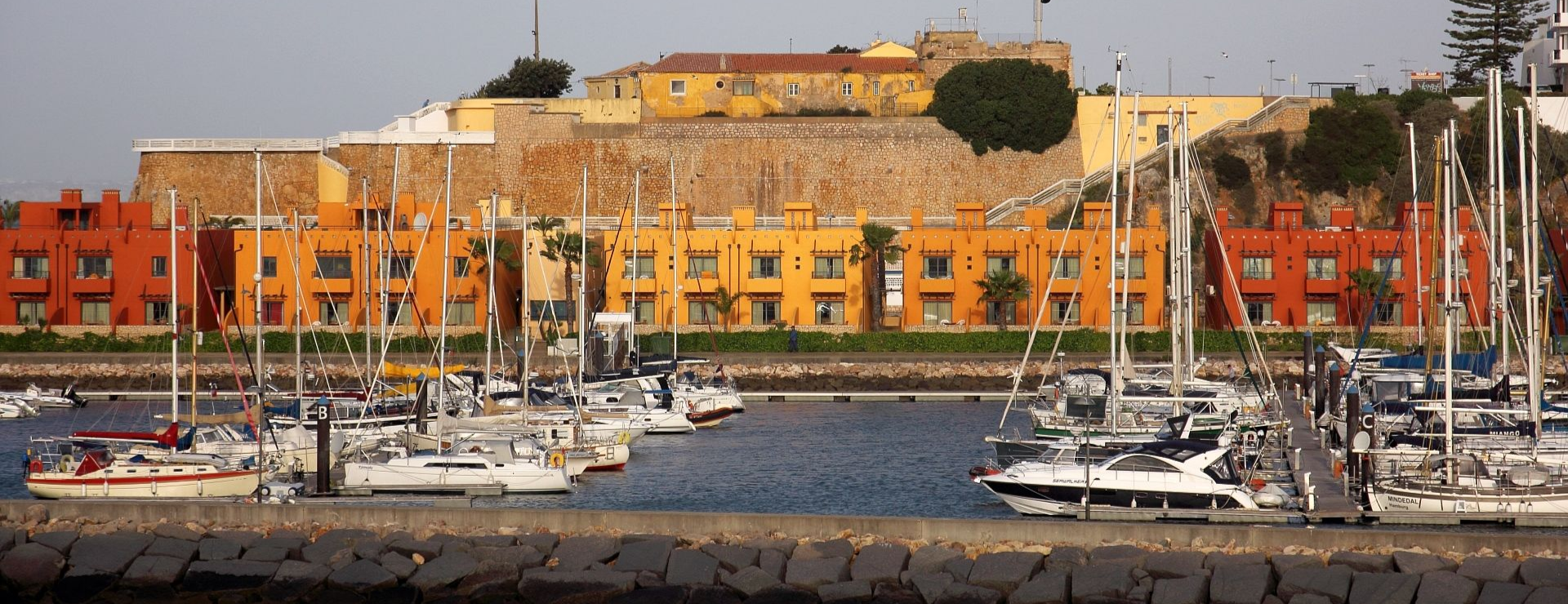
Portimão marina with traditional Portuguese fishing boats and modern yachts
The seasonal pricing was introduced specifically to soften the cost for off-season travellers and encourage shoulder-season tourism. November visits to Albufeira cost half of what they would in July.
Explore Algarve municipal tourism information at Visit Algarve, the regional tourism authority.
For our Algarve holiday homes, the tax is collected on arrival and added as a separate line on your final statement.
Madeira (Funchal) tourist tax 2026
€2 per person per night, capped at 7 consecutive nights. Children under 13 are exempt.
The Funchal tax applies across the Município do Funchal and to most other Madeira municipalities (Câmara de Lobos, Santa Cruz, Santana, Calheta, Porto Moniz, Ribeira Brava, São Vicente, Machico, Ponta do Sol). Always confirm the rate with your specific property since a couple of smaller councils have not yet adopted the measure.
Official Funchal Council information sits at Câmara Municipal do Funchal.
Cascais tourist tax 2026
€1 per person per night, capped at 7 consecutive nights. Children under 13 are exempt.
Cascais introduced its tourist tax at €1 — half the Lisbon rate. As a premium coastal destination 30 minutes from central Lisbon by train, Cascais has kept its tax deliberately lower than the capital to keep weekend stays competitive. The rate applies to all licensed accommodation in the Município de Cascais, including hotels, Alojamento Local properties, and short-term vacation rentals.
Discover Cascais visitor information at Visit Cascais or the Câmara Municipal de Cascais.
Who is exempt from the Portuguese tourist tax
Exemptions vary by municipality, but the most common rules across Portugal in 2026:
- Children under 13 — exempt in every municipality that applies the tax (universal).
- Patients receiving medical treatment in the municipality — with documentation from a Portuguese hospital or clinic.
- Family members accompanying a hospitalised patient — typically one or two adults, with documentation.
- Residents of the municipality itself — Portuguese residents typically prove this with a Atestado de Residência from the junta de freguesia.
- Nights 8 onwards — only the first 7 nights of any continuous stay are taxed.
- Some business travellers — Albufeira and Faro accept exemption for travellers in town for council-recognised conferences. Documentation required.
Students on academic stays of more than 30 nights are sometimes exempt; check the rules of the specific municipality before assuming.
How the tax is collected in Portuguese accommodation
The tourist tax is a legal obligation on the accommodation provider, not the guest. As a host, we collect it at check-in and remit it monthly to the relevant municipality through the official online portal. Failure to collect or remit the tax results in fines for the host — guests cannot refuse to pay.
A few practical notes:
- Booking.com and Airbnb usually do not include the tax in the displayed price. The Booking.com checkout sometimes flags it as a separate charge, but most hosts collect it on arrival.
- Alojamento Local hosts are required to issue a receipt for the tax separately from the accommodation invoice. Keep the receipt for any expense claims.
- Payment methods vary by property — most hosts accept cash and card; some require cash for the tax specifically because of how it interacts with municipal accounting.
If you manage an Alojamento Local property and want help streamlining tourist-tax collection, see our guide to Portugal property management.
What property owners need to know
For Alojamento Local owners, the tourist tax is one of the operational details that takes the longest to get right. Three things matter:
- Register with the municipality. Before you can legally collect the tax, you must register your AL property with the câmara and obtain a tax-collection certificate.
- Issue compliant receipts. Every guest charged the tax must receive a receipt showing the amount, the number of nights, and the municipality. Most professional channel managers (Guesty, Hostaway, Lodgify) support this out of the box.
- Remit monthly via the official portal. Most municipalities require monthly remittance through their online system. Late remittance triggers fines that scale with the number of guests.
If you are operating an Alojamento Local property and want to delegate the entire compliance flow, our property-management team handles registration, collection, receipts, and monthly remittance across Cascais, Lisbon, the Algarve, and Madeira.
How much is the tourist tax in Lisbon in 2026?
Lisbon charges €4 per person per night, capped at 7 nights. The rate doubled from €2 to €4 in September 2024 and has held at €4 through 2026. Children under 13 are exempt. A 7-night stay for one adult costs €28 in tourist tax; a couple staying a full week pays €56. The tax applies to all licensed accommodation across the Município de Lisboa, including hotels, hostels, guesthouses, and short-term rentals.
Why did Lisbon double its tourist tax?
Lisbon City Council voted to increase the rate to fund cleaning, public transport, beach maintenance, and infrastructure under pressure from rapidly growing visitor numbers. The decision was approved in mid-2024 and took effect on 1 September 2024. The increase was forecast to roughly double the city’s annual tourist-tax revenue.
Do all Algarve municipalities charge tourist tax?
No. As of May 2026, only seven of the Algarve’s 16 municipalities apply the tax: Albufeira, Faro, Lagoa, Loulé, Olhão, Portimão, and Vila Real de Santo António. The remaining nine (including Lagos, Tavira, Silves, and Aljezur) do not currently collect a tourist tax, although several have publicly discussed introducing one.
Is the tourist tax included in my Airbnb price?
Usually no. The tax is collected at check-in by the host. Some Airbnb hosts include it in the listing price as a workaround, but most charge it separately on arrival. Confirm with the host in writing before you travel, because being asked to pay an unexpected charge on arrival is the most common cause of guest complaints around the tax.
Do children pay the Portuguese tourist tax?
No. Children under 13 are exempt in every Portuguese municipality that applies the tax. You may be asked to show ID confirming the child’s age at check-in. A family of four (two adults, two children under 13) staying in Lisbon for a week pays €56 in total, not €112.
How is the tourist tax in Madeira different from the mainland?
Funchal and most Madeira municipalities apply a flat €2 per person per night, capped at 7 nights. There is no seasonal pricing on Madeira, unlike the Algarve. The Madeira regional government has not signalled any rate change for 2026.
What happens if my host does not charge me the tourist tax?
It usually means the host is absorbing the cost themselves or has included it in the room rate. You are not legally required to demand a separate charge — the obligation falls on the host. However, if the host bills you and you refuse to pay, you can be denied check-in.
Resources
- Visit Portugal — national tourism authority, official information on regional taxes.
- Câmara Municipal de Lisboa — Lisbon city council, official tourist-tax rules.
- Câmara Municipal do Porto — Porto city council, tax framework and exemptions.
- Visit Algarve — regional tourism information for the Algarve.
- Câmara Municipal do Funchal — Funchal city council, Madeira tourist-tax rules.
- Visit Cascais — Cascais visitor information.
- Visit Madeira — Madeira regional tourism portal.
- Browse our Portugal Portfolio properties — see exact tax-inclusive pricing on every listing.
Plan your Portugal stay
Ready to book? Browse our properties across Cascais, Lisbon, the Algarve, and Madeira — every listing shows the applicable tourist tax up front, so there are no surprises at check-in. Our Cascais-based team handles the collection paperwork, so all you need to do is enjoy your stay.
Are you a property owner in Portugal?
If you own an Alojamento Local property and want to delegate tourist-tax registration, collection, and monthly remittance, our Portugal property management team handles the entire compliance flow across Cascais, Lisbon, the Algarve, and Madeira. One monthly report, no municipal-portal logins.
Share to social media
Leave a comment
More posts
Blog corner